

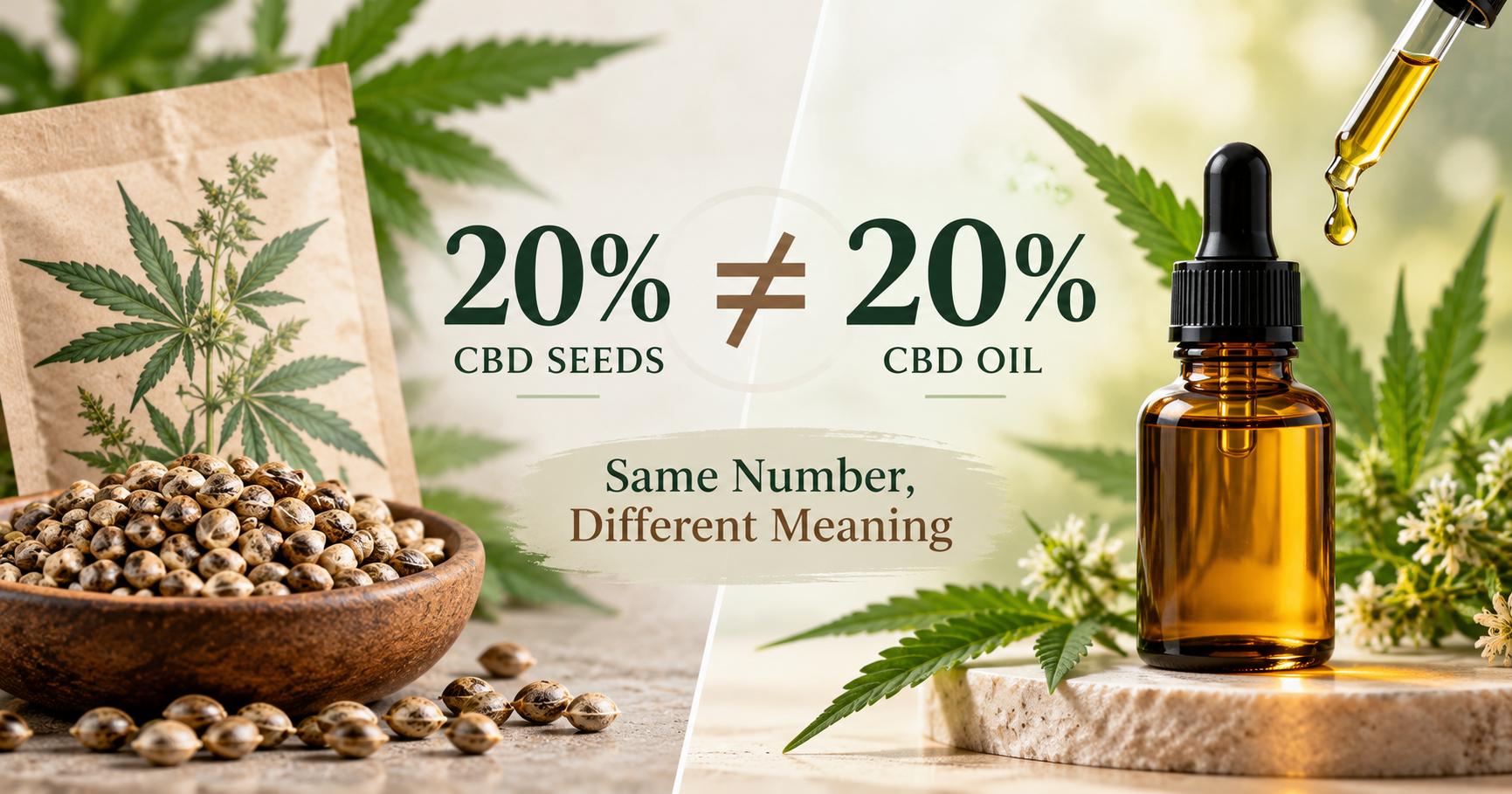
A cannabis strain is described as reaching 20% CBD. A bottle of oil also says 20% CBD. At first glance, those figures look directly comparable. They aren’t. The number may be identical, but it describes CBD at two very different stages: first as part of the cannabinoid profile associated with plant material, and later as the concentration of a formulated product. Between the two sit biological variation, harvesting, extraction and formulation. Understanding that distinction makes percentages much more useful. Instead of simply asking, “How much CBD?”, the better questions are: 20% of what, measured at which stage, and in what form?
A cannabis strain is described as reaching 20% CBD. A bottle of oil also says 20% CBD. At first glance, those figures look directly comparable. They aren’t.
The number may be identical, but it describes CBD at two very different stages: first as part of the cannabinoid profile associated with plant material, and later as the concentration of a formulated product. Between the two sit biological variation, harvesting, extraction and formulation.
Understanding that distinction makes percentages much more useful. Instead of simply asking, “How much CBD?”, the better questions are: 20% of what, measured at which stage, and in what form?
What Does “20% CBD” Mean for Cannabis Genetics?
When a breeder describes a strain as producing around 20% CBD, the figure refers to the expected cannabinoid content associated with the resulting plant material under particular conditions. It does not mean that the seed itself contains 20% CBD, nor should the figure be treated as an immutable property of every plant grown from that genetic line.
Genetics establish potential, but biology introduces variation. Phenotype, environmental conditions and the point at which plant material is harvested can all influence the final cannabinoid profile. A breeder’s percentage is therefore best understood in the context in which it was measured or reported, rather than as a guarantee that every specimen will return exactly the same laboratory result.
What Does 20% Mean on a Bottle?
Once we move from plant material to a finished product, the frame of reference changes. Concentrations found on CBD oil describe a formulated product rather than the cannabinoid potential associated with a cannabis genetic.
That distinction sounds small, but it prevents a surprisingly easy comparison error. A 20% strain and a 20% oil are not two versions of the same measurement. One concerns cannabinoids in biological material; the other concerns CBD concentration after extraction and formulation.
When reading a finished product label, it also helps to look for the total quantity of CBD and the bottle volume rather than relying on the percentage alone. Those figures provide context for what the percentage actually represents.
This is why “higher percentage” cannot simply be translated from a strain description to an oil label. Before comparing two numbers, check what is actually being measured and the units used.
The Missing Step: What Happens Between Plant and Bottle?
The plant does not become a bottle of oil while preserving every percentage on its original specification sheet. CBD first has to be extracted from plant material and then incorporated into a finished formulation.
UK government guidance explains that CBD extracts can be derived from different parts of hemp or cannabis plants and can be selectively extracted, concentrating CBD in the process. It also notes that some extraction processes can alter other chemical components. In other words, extraction is not simply a matter of transferring an unchanged cannabinoid profile from one container to another.
For readers interested in that broader journey, The Vault’s earlier article on cannabis seeds and CBD looks at the relationship between genetics and the eventual CBD product. The important distinction here is that each stage creates a new context for interpreting the numbers.
The UK’s official guidance on cannabidiol is particularly useful on this point: selective extraction can concentrate CBD, while the composition and regulatory status of the finished product depend on more than one headline percentage.
20% vs 20%: What Are We Actually Comparing?
| 20% associated with a strain | 20% on CBD oil | |
| What does it describe? | Cannabinoid content associated with plant material | CBD concentration in a finished formulation |
| Stage | Plant material | Finished product |
| Can it vary? | Yes, biological and environmental factors matter | The product is formulated to a stated specification |
| What shapes the figure? | Genetics, phenotype, growing conditions and harvest | Extract concentration and final formulation |
| Are the two 20% figures directly comparable? | No — they describe different materials at different stages. |
Why the CBD Percentage Doesn’t Tell the Whole Story
A single percentage is useful, but it is not a complete chemical description. Cannabis contains multiple cannabinoids and other compounds, and extraction can change their relative concentrations. Finished products can also differ according to how an extract has been processed and formulated.
That means a sensible reading habit is to resist treating the largest number on a specification or label as a complete measure of the product. For plant material, consider how the cannabinoid figure was obtained and whether it represents a typical value, a range or a maximum. For a finished formulation, consider the percentage alongside the total CBD quantity, volume and available compositional information.
Keep this rule in mind: 20% in a strain description, 20% in an extract and 20% in a finished formulation are not automatically interchangeable figures.
The Bottom Line: Always Ask What the Percentage Describes
CBD percentages become much easier to understand once they are tied to a stage in the journey from genetics to finished product. A figure associated with a strain tells us something about plant material and its cannabinoid profile. A percentage on an oil belongs to a product that has already passed through extraction and formulation.
So when two CBD products or descriptions display the same number, don’t start by comparing the percentages. Start by asking what was measured, where in the process it was measured and what the number actually represents. The answer usually tells you far more than the percentage alone.
