

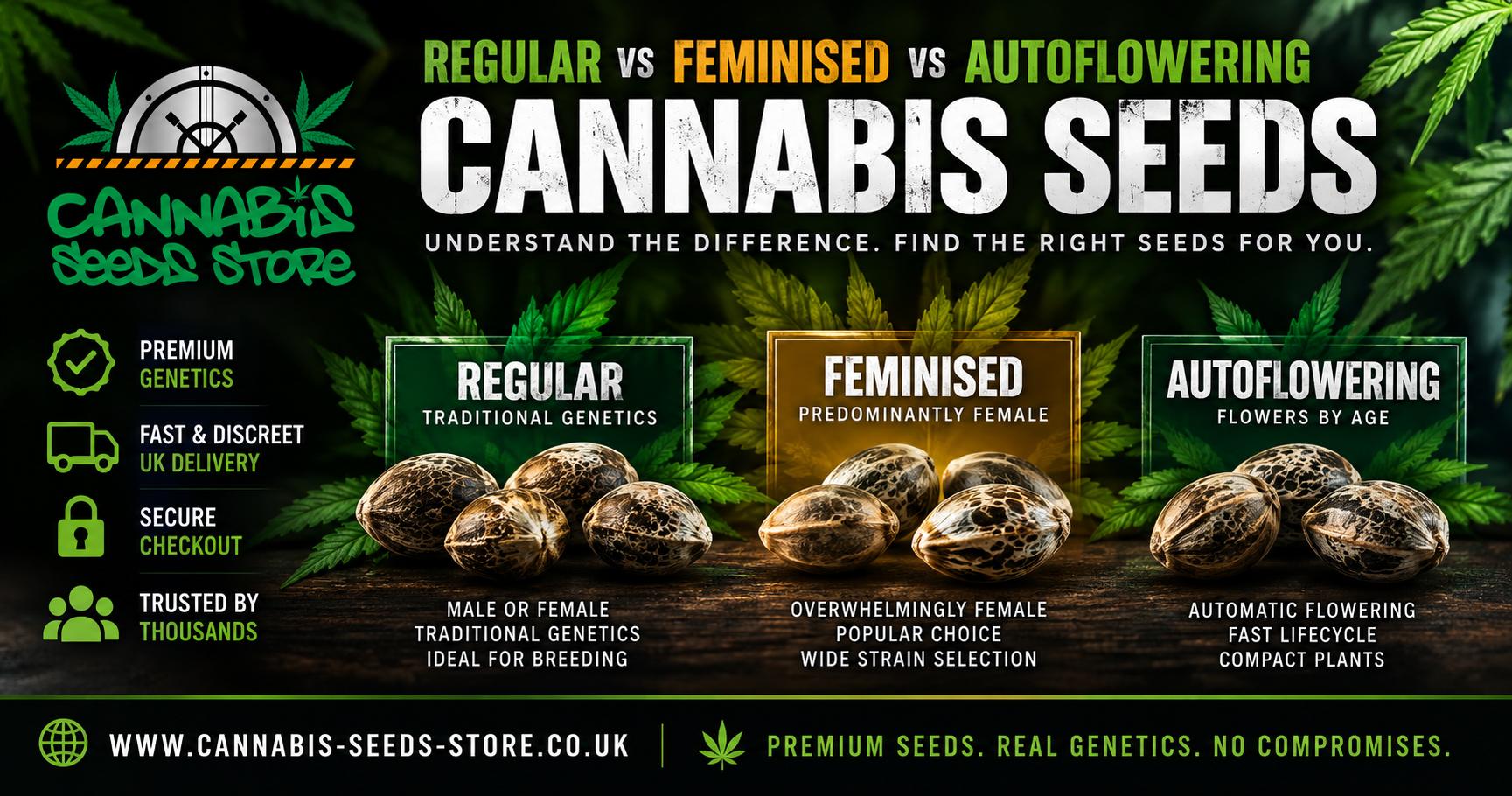
Regular vs Feminised vs Autoflowering Cannabis Seeds: What’s the Difference?
If you’re browsing cannabis seeds for the first time, one of the first things you’ll notice is that they’re usually divided into three main categories: regular cannabis seeds, feminised cannabis seeds and autoflowering cannabis seeds.
They may all look remarkably similar sitting inside a packet, but genetically there are some important differences.
Understanding those differences is useful whether you’re interested in cannabis genetics as a collector, researching the history of different varieties or simply trying to understand what all the terminology on a seed bank website actually means.
At The Vault Cannabis Seeds Store, we stock thousands of cannabis strains from breeders around the world, covering regular, feminised and autoflowering genetics. With so much choice available, we’ve put together this straightforward guide explaining what each term means, why the different types exist and how they compare.
What Are Regular Cannabis Seeds?
Regular cannabis seeds are essentially the traditional form of cannabis seed.
Before feminised and autoflowering varieties became widely available, regular seeds were what virtually everybody associated with cannabis genetics.
Regular cannabis seeds can develop into either male or female plants. In broad terms, each individual seed has roughly an even chance of expressing as male or female, although actual ratios from a particular batch can naturally vary.
This is an important distinction because cannabis is generally a dioecious plant, meaning male and female reproductive structures ordinarily develop on separate plants.
Regular seeds therefore preserve both sides of the genetic equation.
For cannabis breeders and collectors interested in traditional breeding lines, this can make regular seeds particularly significant. Male plants provide pollen and contribute approximately half of the genetic material involved in creating offspring.
This is why many preservation projects and breeding programmes continue to use regular cannabis seeds even though feminised varieties have become much more common commercially.
Why Are Regular Cannabis Seeds Still Important?
You could be forgiven for thinking regular cannabis seeds had disappeared once feminised seeds became widely available.
They haven’t. In fact, regular genetics remain an important part of the cannabis breeding world.
Some specialist breeders prefer working with regular lines because they provide access to both male and female expressions of a particular genetic family. Regular seeds can therefore be particularly valuable when preserving older cultivars, exploring landrace populations or creating new crosses.
You’ll still find regular versions of established cannabis varieties alongside unusual heritage and landrace genetics.
For collectors interested in cannabis breeding history, regular seeds can also represent genetics closer to the way many famous strains were originally developed.
What Are Feminised Cannabis Seeds?
Feminised cannabis seeds are seeds produced specifically to overwhelmingly develop into female plants.
Their arrival represented one of the biggest changes in the commercial cannabis seed industry.
Traditional regular seeds leave the sex of an individual plant uncertain until it expresses its characteristics. Feminised genetics largely remove that uncertainty.
Cannabis breeders achieve this without introducing male genetics into the breeding process. Instead, pollen is produced from selected female genetic material and used to pollinate another female plant, or sometimes another part of the same plant depending on the breeding method.
Because the resulting seed does not receive a male Y chromosome, the offspring are overwhelmingly female.
It is worth noting that describing feminised seeds as “100% guaranteed female” isn’t scientifically sensible. Cannabis biology can be affected by genetics and environmental factors, and reputable breeders generally avoid absolute guarantees.
Nevertheless, properly produced feminised cannabis seeds have a very high probability of developing as female plants.
Why Did Feminised Cannabis Seeds Become So Popular?
Convenience is a major reason.
For people interested in female cannabis genetics, regular seeds introduce an unknown variable. A pack containing ten regular seeds could produce a mixture of males and females.
Feminised seeds make the outcome considerably more predictable.
That changed the commercial seed industry dramatically.
As breeding methods improved, feminised cannabis seeds became increasingly reliable and breeders began releasing feminised versions of both established classics and completely new hybrids.
Today, browse almost any major cannabis seed catalogue and feminised varieties will usually account for a substantial percentage of what’s available.
At The Vault Cannabis Seeds Store, our feminised collection covers everything from old-school names such as Northern Lights, Skunk and White Widow through to contemporary Cookies, Gelato, Runtz, Kush and Zkittlez-influenced genetics.
Are Feminised Seeds Genetically Modified?
This is a surprisingly common question, and the answer is no.
Feminised cannabis seeds are not genetically modified organisms (GMOs) simply because they have been feminised.
Traditional feminisation relies on manipulating the reproductive expression of selected cannabis plants so female genetic material produces pollen. It does not involve directly inserting foreign genes into the plant’s DNA using genetic engineering.
Feminisation is therefore a breeding technique rather than genetic modification in the GMO sense.
What Are Autoflowering Cannabis Seeds?
Autoflowering cannabis seeds are genetically different from conventional photoperiod cannabis varieties.
The key distinction is contained in the name: autoflowering cannabis plants transition into their reproductive phase primarily according to maturity rather than relying on the seasonal change in daylight that triggers flowering in photoperiod varieties.
That characteristic originates from cannabis populations commonly associated with Cannabis ruderalis.
Ruderalis-type cannabis evolved in regions where summers can be relatively short and seasonal conditions challenging. Rather than relying exclusively on changing daylight hours, these plants developed the ability to complete their reproductive cycle according more closely to age.
Cannabis breeders recognised the potential value of this characteristic and began crossing autoflowering cannabis seeds genetics with established drug-type cannabis varieties.
The early results weren’t always spectacular.
First-generation commercial autoflowers were often comparatively small and lacked some of the characteristics associated with established photoperiod genetics.
Modern autoflowering genetics, however, are a very different proposition.
After generations of selective breeding, specialist breeders have developed autoflowering versions of an enormous range of genetic families.
Are Autoflower Seeds Always Feminised?
This is where the terminology sometimes causes confusion.
Autoflowering and feminised don’t technically describe the same characteristic.
“Autoflowering” describes the plant’s flowering behaviour.
“Feminised” describes the expected sexual expression of the seed.
Consequently, an autoflowering seed can theoretically be either regular or feminised.
In today’s commercial cannabis seed market, however, the majority of autoflowering seeds sold to consumers are feminised autoflowers. Regular autoflowering genetics do exist, particularly for specialist breeding purposes, but they’re much less commonly encountered.
So when you see a product described simply as an “Auto” at a commercial seed bank, it will often be a feminised autoflower, but it’s always worth checking the breeder’s actual product description rather than assuming.
Photoperiod vs Autoflowering Cannabis Seeds
Another term you’ll frequently encounter is photoperiod.
Both regular and feminised cannabis seeds can be photoperiod varieties.
A photoperiod cannabis plant responds to changes in the duration of light and darkness. In nature, shortening days provide a seasonal signal associated with the approach of autumn.
Autoflowering genetics behave differently because their transition towards flowering is driven predominantly by the plant’s developmental age rather than that same photoperiodic trigger.
This gives us an important distinction:
Regular vs feminised primarily describes sexual genetics.
Photoperiod vs autoflowering describes flowering behaviour.
Those categories overlap rather than being direct opposites.
Regular, Feminised and Autoflowering Cannabis Seeds Compared
| Seed type | Male or female potential | Flowering type | Common reason for interest |
|---|---|---|---|
| Regular seeds | Male or female | Usually photoperiod | Traditional genetics and breeding |
| Feminised seeds | Overwhelmingly female | Usually photoperiod | Predictable female genetics |
| Feminised autoflowers | Overwhelmingly female | Autoflowering | Female genetics with the autoflower trait |
| Regular autoflowers | Male or female | Autoflowering | Specialist breeding and preservation |
This is probably the simplest way to understand the entire subject.
A seed being feminised doesn’t automatically tell you whether it is photoperiod or autoflowering, and a seed being autoflowering doesn’t technically tell you whether it is regular or feminised.
You need both pieces of information to understand exactly what you’re looking at.
Do Autoflowering Seeds Produce Different Genetics?
Yes, in the sense that the autoflowering trait must be present within their genetic ancestry.
Modern autoflowers are generally hybrids developed over multiple generations to combine autoflowering characteristics with desirable traits selected from other cannabis genetic lines.
This is why you’ll now encounter automatic interpretations of many famous strain families.
Breeders have spent years stabilising these lines so the autoflowering characteristic is reliably inherited while retaining as much as possible of the identity associated with the photoperiod parent genetics.
That breeding work explains why contemporary autoflowers are substantially more sophisticated than many of the earliest commercial automatic strains.
Which Type of Cannabis Seed Is Best?
There isn’t a universal answer because regular, feminised and autoflowering cannabis seeds were developed for different purposes.
Someone interested in traditional breeding material may specifically seek regular genetics because both male and female plants are important to conventional breeding.
A collector interested in a particular female genetic line may prefer feminised seeds.
Someone researching the development of automatic cannabis genetics may be particularly interested in autoflowering strains.
Rather than thinking of one category as inherently “better”, it makes more sense to understand what each represents and choose according to what interests you.
The breeder matters too.
A carefully developed regular strain from a respected breeder isn’t automatically inferior to a feminised strain, just as a feminised photoperiod isn’t automatically superior to an autoflower.
Quality ultimately depends on the genetics and the breeding work behind them.
Choosing Cannabis Genetics by Breeder
Once you understand seed types, the next thing worth considering is the breeder.
Different seed banks specialise in very different areas of cannabis genetics.
Some cannabis seed breeders have decades of experience preserving traditional varieties. Others specialise in modern autoflowers, landrace genetics, American hybrids or feminised versions of famous strains.
That’s part of what makes collecting cannabis genetics so interesting.
At The Vault Cannabis Seeds Store, you’ll find regular, feminised and autoflowering cannabis seeds from a huge selection of international breeders, making it easier to compare genetics rather than limiting yourself to a single seed company.
If you’re exploring our catalogue, the filters and individual breeder descriptions can help narrow down the selection according to the type of seed and genetics you’re interested in.
Frequently Asked Questions About Cannabis Seed Types
What is the difference between regular and feminised cannabis seeds?
Regular cannabis seeds can develop as either male or female plants. Feminised cannabis seeds are specifically bred so the resulting plants are overwhelmingly female.
What is the difference between feminised and autoflowering cannabis seeds?
Feminised describes expected sexual expression, whereas autoflowering describes flowering behaviour. Many commercial autoflower seeds are also feminised, meaning a cannabis seed can be both autoflowering and feminised.
Can autoflower cannabis seeds be regular?
Yes. Regular autoflower seeds exist and can produce male or female plants. However, feminised autoflower seeds are considerably more common in the consumer cannabis seed market.
Are regular cannabis seeds better than feminised seeds?
Neither is inherently better. They serve different purposes. Regular seeds retain both male and female genetics and are particularly relevant to traditional breeding, while feminised seeds are designed to overwhelmingly produce female plants.
Are feminised cannabis seeds genetically modified?
No. Conventional feminised cannabis seeds are produced using selective breeding and techniques that encourage female plants to produce pollen. This isn’t the same process as genetic engineering used to create a GMO.
What does photoperiod cannabis seed mean?
Photoperiod cannabis varieties respond to changes in the duration of light and darkness as part of their flowering response. This contrasts with autoflowering genetics, where maturity plays the principal role in triggering the transition.
Explore Cannabis Seeds at The Vault
Understanding the terminology makes browsing cannabis genetics considerably easier.
Remember the two fundamental distinctions: regular versus feminised relates primarily to sexual expression, while photoperiod versus autoflowering relates to flowering behaviour.
Once you’ve got that straight, descriptions such as “feminised photoperiod”, “feminised autoflower” and “regular photoperiod” suddenly make a lot more sense.
At The Vault Cannabis Seeds Store, you can explore thousands of cannabis strains from breeders around the world, including extensive collections of regular cannabis seeds, feminised cannabis seeds and autoflowering cannabis seeds.
Whether your interest lies in historic genetics, modern hybrids, rare breeder lines or simply expanding your cannabis seed collection, understanding these three categories is a great place to start.
Disclaimer
Remember: It is illegal to germinate cannabis seeds in many countries including the UK. It is our duty to inform you of this fact and to urge you to obey all of your local laws to the letter. The Vault only ever sells or sends out seeds for souvenir, collection or novelty purposes.
